Picture a hotel kitchen at 10 in the morning. Lunch starts in two hours. Three cooks stand at a table, cutting a mountain of onions, carrots, and cabbage. Their wrists hurt, and the pieces come out in all sizes.
A commercial vegetable cutting machine solves this problem. It cuts a huge load in a short time, and every piece looks the same. In this guide, we will look at its types, its uses, and how to buy the right one.
What Is a Commercial Vegetable Cutting Machine?
A commercial vegetable cutter machine is a kitchen machine for big jobs. It slices, dices, chops, and shreds vegetables in large amounts. You load the vegetables, switch it on, and the cut pieces come out.
Restaurants, hotels, caterers, canteens, and food factories use it. It does not replace the knife fully. You still need a knife for small work. But the machine does the heavy part, and your cooks can spend that time on real cooking.
People call it by many names. You may hear:
- Commercial vegetable cutter
- Vegetable maker machine
- Vegetable making machine
- Veg machine
Some buyers even search for vego machines when they want a quick cutter. All of these names point to the same kind of equipment.
Types of Commercial Vegetable Cutting Machines
Not every machine does the same job. Here are the main types you will find in the market:
- Slicers cut vegetables into thin, flat slices. Potato chips and onion rings are good examples.
- Dicers cut vegetables into small cubes. Cooks use them for fried rice, salads, and curries.
- Shredders and graters make fine strips. They suit cabbage, carrot, and coleslaw.
- Multi-function machines do many of these jobs. You just change the blade.
Multi-Function Commercial Vegetable Cutting Machine
A multi-function model is the best pick for most kitchens. Your menu changes, and so do your cuts. With one machine and a few blades, you can slice in the morning and shred in the evening.
You save money, and you save space too. A small kitchen cannot hold four different machines.
Big food plants often go for an industrial vegetable cutting machine. It handles huge loads for long hours. It is bigger, heavier, and costs more. A normal restaurant rarely needs one.
Commercial Vegetable Cutter vs Vegetable Dicer
Many buyers mix these two up, so let’s clear it.
A commercial vegetable cutter is flexible. It slices, chops, shreds, and more, depending on the blade you fit.
A vegetable dicer machine does one thing. It makes cubes. It does that job well, but it cannot make slices or shreds.
So how do you choose?
- If your menu has many dishes, pick the cutter.
- If you only need cubes all day, pick the dicer.
- If you are not sure, pick the cutter. You can always do more with it.
How a Vegetable Making Machine Works
A vegetable making machine is easy to run. Even a new staff member can learn it in a few minutes.
Here is the usual process:
- Fit the right blade or disc for the cut you want.
- Open the top door and load the vegetables.
- Close and lock the door. This keeps hands safe.
- Switch on the machine.
- The motor spins the blade, and the cut pieces drop out.
- Switch off and wipe the machine clean.
The blade decides the cut. A thin disc makes slices. A shredding disc makes strips. So always pick your blade first.
Benefits of a Commercial Vegetable Cutting Machine
Why do kitchens switch to a machine? Here are the real gains:
- It saves time. A full day of prep can finish in a few hours.
- The cuts match. Pieces cook at the same speed, and the dish looks neat.
- It cuts labour. You need fewer people at the prep table.
- It is safer. Staff handle fewer sharp knives.
- It is easy to clean. Stainless steel parts wipe down fast.
- It reduces waste. Even cuts mean fewer messy leftovers.
Think about a caterer with a wedding order for 500 people. By hand, that is a long night. With a machine, it is a short morning.
How to Choose the Right Machine
Before you pay, check these points:
- Capacity: How many kilos do you cut each hour? Match it to your daily need.
- Blades: Ask which cuts you get and if extra blades are sold.
- Motor: It must handle hard vegetables like carrot and raw papaya.
- Body: Stainless steel is food-safe and lasts longer.
- Power supply: Check if it runs on single-phase or 3-phase power.
- Size: Measure your counter or floor space first.
- Safety: Look for a door lock.
- Warranty: Get the terms in writing.
Do not buy a bigger machine than you need. Extra power only adds to your bill.
Commercial Vegetable Cutting Machine for Different Businesses
Different businesses use the machine in different ways:
- Restaurants: They use it for the lunch and dinner rush.
- Hotels: They have large and steady daily volumes.
- Caterers: They cut big batches for weddings and events.
- Canteens and hospitals: They prepare food for many people at fixed times.
- Food factories: They need steady, even cuts for packed foods.
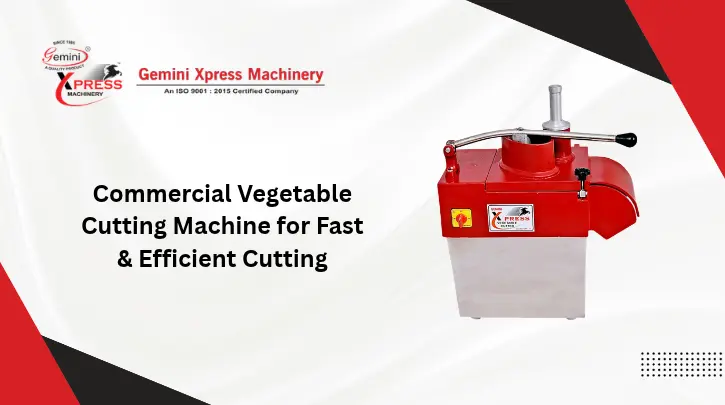
Gemini Commercial Vegetable Cutter Machine
Gemini Machinery has made machines since 1985. Their commercial vegetable cutter suits hotels, restaurants, catering services, and food processing units.
Here are the full details:
- Cuts: Slice, dice, chop, and shred. It also does julienne and grating with the right blade.
- Capacity: 100 kg per hour
- Blade: Stainless steel, with interchangeable blades and discs
- Body: Aluminium dome with stainless steel covering
- Safety: Top door with a stainless steel lock
- Motor: 0.5 HP, single phase, 220 V, 50 Hz
- Starter: Inbuilt electronic starter
- Grade: Semi-automatic
- Size: 20 x 12 x 21 cm
- Weight: 35 kg
- Warranty: One-year manufacturer warranty
What does this mean for you? The motor is strong enough for tough vegetables and long runs. The machine uses less energy. The single-phase motor means you do not need special wiring. And the stainless steel parts need only a quick wipe between batches.
The site does not show a price. You need to send a quote request by phone or WhatsApp. The team can also help you pick the right blade set for your menu.
Stay connected for more updates of the latest machines, factory tours, and helpful buyer tips by following Gemini Machinery on YouTube and LinkedIn.
FAQs
1. What can a commercial vegetable cutting machine cut?
It slices, dices, chops, and shreds. You change the blade for each style.
2. How much can it cut in an hour?
The Gemini model handles up to 100 kg per hour.
3. Can it cut hard vegetables?
Yes. The motor handles tough vegetables and long use.
4. Is it easy to clean?
Yes. A quick wipe between batches is usually enough.
5. Does it need 3-phase power?
No. The Gemini model runs on a 0.5 HP, single-phase motor.