
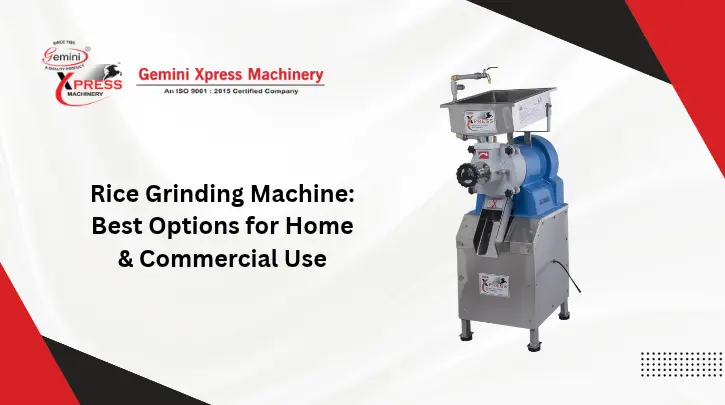
Soft idli and crisp dosa start with smooth batter. Grinding by hand takes hours and tires your arms. A good rice grinding machine does the same job in minutes. It saves time, effort, and money.
But the market has many choices. Some are small and some are big. Some suit a home kitchen and some suit a busy shop. This guide explains everything in simple words, so you can pick the right one.
What Is a Rice Grinding Machine?
A rice grinding machine turns soaked rice and dal into soft, smooth batter. You add the grains and water. The machine does the rest.
People use different names for it:
- Rice grinder
- Wet grinder
- Wet rice grinding machine
- Instant batter machine
It does not grind rice alone. It also handles:
- Ragi
- Wheat
- Urad dal
- Millets
So one machine can help you make idli, dosa, vada, and more.
How Does a Rice Grinding Machine Work?
The working is easy to understand:
- You soak the rice for a few hours.
- You add the soaked rice and water to the drum.
- The motor turns the drum and the grinding blades.
- The grains get crushed into a fine paste.
- You pour out fresh batter and clean the drum.
A good rice grinder does this at a steady speed. This keeps the batter cool. Cool batter ferments well and gives fluffy idlis.
Gemini Machinery models use an 8-inch double-side stainless steel blade. They also have a built-in automatic cleaning system. As per the maker, the right softness comes at the first loading. This saves electricity.
Why Use a Machine Instead of Hand Grinding?
Let’s compare the two in a simple way:
- Time: A machine grinds 1 kg of rice in about one minute on some models.
- Effort: You do not need to push or turn anything.
- Quality: Every batch comes out smooth and even.
- Hygiene: Stainless steel parts are easy to wash.
- Cost: You save on labour and power over time.
For a shop, this is a big gain. For a home, it is a big relief.
Rice Grinder Machine for Home
Many families now look for a rice grinder machine for home. It is a smart choice if you make batter every few days.
Check these points first:
- Size: Measure your kitchen counter or floor space.
- Height: A low-height model fits better in a small kitchen.
- Power supply: Most homes have single-phase power. Many strong machines need 3-phase.
- Noise and weight: Heavy machines need a fixed spot.
Please note one thing. Gemini lists all its wet grinders for commercial use. Still, some models come with a single-phase motor option. So ask the team before you order for home.
Wet Rice Grinding Machine vs Rice Blender
Many people ask about a rice grinder vs a rice blender. They look alike but work in different ways.
A rice blender machine spins sharp blades at high speed. It is quick and works well for small amounts. But it heats up fast. Hot batter can turn sticky and may not ferment well.
A wet rice grinding machine crushes grains slowly. It keeps the batter cool and fluffy. It also handles big loads without stress.
Here is a quick view:
- Blender: fast, small quantity, more heat
- Wet grinder: steady, large quantity, less heat
- Blender: needs frequent rest
- Wet grinder: runs for long hours
If you make batter daily, choose the wet grinder. If you only need a little paste now and then, a blender is enough.
How to Choose a Rice Grinding Machine
A smart buyer checks many things. Use this list before you pay.
- Capacity: How many kilos do you grind each hour? Some models do 30 kg and some do 70 kg.
- Motor power: Pick 1.5 HP, 2 HP, or 3 HP based on your load.
- Power supply: Check single-phase or 3-phase.
- Body material: Stainless steel 304 is rust-resistant and easy to clean.
- Design: Open-type drums are quick to wash.
- Bearings and belt: Good parts mean fewer repairs.
- Warranty: Ask for the terms in writing.
- Support: Check if the maker gives service after the sale.
Rice Grinder Machine for Shop
A rice grinder machine for shop use must work for many hours. Think about your daily batter need before you buy. A tiffin centre needs less than a large hotel.
Location also matters. Choosing the right location in Ayodhya can bring steady customers. Pilgrims, local families, and workers all look for fresh, hot food. A strong rice grinding machine helps you serve it fast.
For a food business, look for:
- High hourly capacity
- A strong motor
- Easy cleaning between batches
- A solid stainless steel body
Best Rice Grinding Machine for Different Uses
Gemini Machinery has made machines since 1985. All models below come with a one-year manufacturer warranty. They are semi-automatic. They use NACHI (Japan) bearings and a FENNER belt. They grind rice, ragi, wheat, urad dal, and millets.
Low Height Model Stainless Steel Doom Open Type (Model 5)
- Capacity: 30 kg per hour
- Motor: 1.5 HP, single phase, 220 V
- Blade: 6-inch double-side stainless steel
- Body: Stainless Steel 304 food grade
- Size: 70 x 46 x 110 cm
- Weight: 90 kg
- Best for: small kitchens and a first rice grinding machine
Low Height Model Aluminum Doom Open Type (Model 4)
- Capacity: 1 kg per minute and 70 kg per hour
- Motor: 2 HP single phase, or 3 HP 3 phase
- Blade: 8-inch double-side stainless steel
- Cover: aluminum dome with full SS cover
- Size: 70 x 46 x 110 cm
- Weight: 90 kg
- Best for: small hotels and canteens with limited space
Aluminum Doom Open Type SS Covering (Model 3)
- Capacity: 1 kg per minute and 70 kg per hour
- Motor: 2 HP single phase, or 3 HP 3 phase
- Blade: 8-inch double-side stainless steel
- Material: aluminum food grade
- Size: 70 x 46 x 120 cm
- Weight: 100 kg
- Best for: restaurants, caterers, and marriage halls
Heavy Molded Stainless Steel Commercial Wet Grinder
- Capacity: 1 kg per minute and 70 kg per hour
- Material: Stainless Steel 304 food grade
- Cover: heavy molded dome with full SS covering
- Motor: 2 HP single phase, or 3 HP 3 phase
- Size: 70 x 50 x 120 cm
- Weight: 120 kg
- Best for: busy kitchens that run all day
Aluminum Doom With Full SS Covering (Model 2)
This is another model from the same range. Check its page for the latest specs.
Features You Get in These Machines
- Strain-free use with low upkeep
- Built-in safety features
- Automatic cleaning for better hygiene
- Open-type design on several models for quick washing
- Energy saving, since batter turns soft at the first loading
Care Tips for a Longer Life
- Rinse the drum right after each use.
- Do not overload the machine.
- Keep the motor dry.
- Check the belt now and then.
- Call the service team if you hear odd noises.
Final Words
Pick a rice grinding machine by your daily load, power supply, and space. A small family needs less. A shop needs more. Match the model to your need and do not pay for extra power you will not use.
The site shows no prices. Send a quote request by phone or WhatsApp, and ask for a clear written quote before you buy.
Stay connected for more updates of the latest machines, factory tours, and helpful buyer tips by following Gemini Machinery on YouTube and LinkedIn.
FAQs
1. What is a rice grinding machine used for?
It makes batter and paste from rice, dal, ragi, and millets.
2. Can I use one at home?
Yes, if your power supply and space suit it. Ask for a single-phase model.
3. Is a rice grinder better than a blender?
For daily batter, yes. A blender suits small, quick jobs.
4. Which model suits a small shop?
The 70 kg per hour models suit most shops. Pick by your daily need.
5. How do I clean it?
Rinse the drum after each use. Open-type models take very little time.