
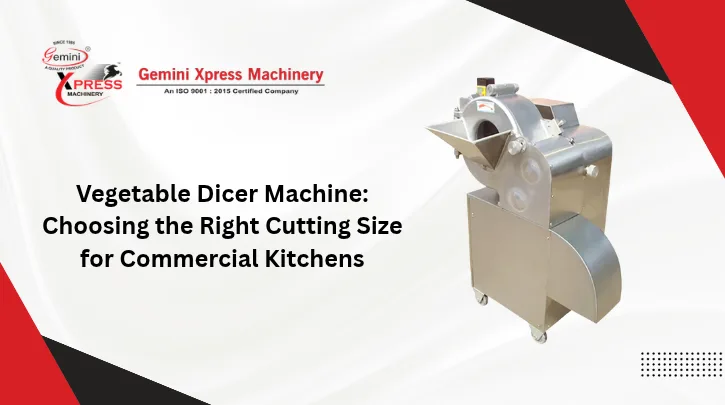
A vegetable dicer machine cuts firm vegetables into even cubes far faster than a knife. The right cutting size depends on your dish, your daily volume, and the blades you use. Choose well, and every batch looks and cooks the same.
This guide explains how a vegetable dicer machine works and which vegetables suit it. It also compares a dicer with a commercial vegetable cutter and lists what to check before you buy.
Hand cutting is slow, and no two cooks cut alike. Pieces differ in size, so some cook faster than others. A vegetable cutting machine removes that problem and gives every batch an even finish.
What Is a Vegetable Dicer Machine and Where Is It Used?
A vegetable dicer machine is a piece of commercial kitchen equipment that cuts vegetables into cubes or small even pieces. Staff feed the vegetables in, and the blades do the cutting.
Hand cutting depends on skill and speed. A machine depends on its blades, so results stay the same from one batch to the next. That is the main gap between manual cutting and a vegetable dicer machine.
Many food businesses use this commercial kitchen equipment:
- Restaurants and hotels
- Catering businesses
- Institutional kitchens
- Food processing units
- Canteens and cloud kitchens
All of these places prepare large amounts of vegetables each day. A vegetable cutting machine helps them finish prep work before service begins, and it frees the cooks for other tasks.
Why Does Cutting Size Matter for a Vegetable Dicer Machine?
Cutting size matters because it controls cooking time, looks, speed, and portions. Even pieces give even results.
Pieces of equal size cook at the same pace. Nothing stays raw while the rest turns soft. That is the biggest gain from a vegetable dicer machine.
Looks matter as well. Neat diced vegetables make salads, curries, and garnishes look cleaner on the plate.
Speed is another gain. A cook may need an hour to dice a sack of potatoes by hand. A machine can finish the same job in a fraction of that time.
Finally, even cuts help with portion control. When every piece is alike, a recipe gives the same result each time, and food costs are easier to track.
So the cutting size you pick shapes the whole dish. Decide on it before you buy any commercial kitchen equipment.
Which Cutting Sizes and Vegetables Suit a Vegetable Dicer Machine?
Small, medium, and large dice suit most dishes, and firm vegetables work best. The exact sizes depend on the grids or blades fitted to your machine.
| Cutting Style | Common Use |
| Small dice | Fried rice, soups, and fillings |
| Medium dice | Curries and mixed vegetables |
| Large dice | Stews and roasted vegetables |
| Fine chopping | Sauces and stuffing |
| Slicing | Salads and vegetable dishes |
These are examples only. Your vegetable dicer machine may offer different sizes, so ask the maker for the list of available blades.
Firm vegetables give the cleanest diced vegetables. Common choices include:
- Potatoes
- Carrots
- Onions
- Tomatoes, if the machine suits them
- Cucumber
- Capsicum
- Other firm vegetables
Not every blade suits every vegetable. A soft tomato needs a different setup from a hard carrot. Confirm compatibility with the manufacturer before you buy.
How Do You Choose the Right Vegetable Dicer Machine for Your Kitchen?
Start with your daily volume, then match the cutting size, motor, blades, and safety features to it. Check these six points:
- Daily needs: Work out your daily vegetable volume and your peak-hour load.
- Available cutting sizes: Check which blade sizes come with the machine and whether you can swap attachments.
- Motor and capacity: Match the motor details and hourly output to your real workload.
- Material and blades: Look at the food-contact material, blade strength, and cleaning needs.
- Safety: Check the feeding method, protective covers, and operating instructions.
- Cleaning and upkeep: Confirm removable parts, spare parts availability, and after-sales support.
Do not buy on price alone. A cheap vegetable cutting machine that stops during peak hours costs more than it saves.
Ask for a demo if you can. Watching the machine cut your own vegetables shows the truth faster than a brochure. A good vegetable dicer machine should also be easy to clean at the end of a long shift. This matters for any commercial kitchen equipment that you use every day.
Vegetable Dicer Machine or Commercial Vegetable Cutter: Which Is Better?
A dicer is better for regular cubes, while a multi-function commercial vegetable cutter suits mixed cutting jobs. Your menu decides the winner.
| Feature | Vegetable Dicer | Multi-Function Cutter |
| Main job | Dicing into cubes | Slicing, dicing, shredding, and chopping |
| Best for | Regular cubed vegetables | Many cutting needs |
| Flexibility | Depends on available grids | Depends on available blades |
| Used in | Salads, curries, and fillings | Restaurants, hotels, and catering |
A kitchen that needs only cubes may be happy with a dicer. A kitchen with a long menu often needs more than one cutting style. In that case, a commercial vegetable cutter saves both space and money.
Check the cutting size options on either machine before you decide. Also ask how easily you can change the blades. A vegetable cutting machine that takes ten minutes to reset will slow your kitchen down.
Why Consider Gemini Machinery’s Commercial Vegetable Cutter as a Vegetable Dicer Machine Option?
Gemini Machinery’s commercial vegetable cutter handles dicing, slicing, chopping, and shredding in one machine. It suits kitchens that want a single vegetable cutting machine for many jobs.
Here are the listed details:
- Cutting jobs: Dicing, slicing, chopping, and shredding.
- Blades: Interchangeable stainless steel blades and discs.
- Capacity: 100 kg per hour, as listed.
- Motor: 0.5 HP, single phase.
- Operation: Semi-automatic.
- Warranty: One year from the manufacturer.
Visit the Gemini machinery page for full specifications. Then ask the team to confirm the available blade options and cutting sizes before you order.
This commercial kitchen equipment works well for restaurants, caterers, canteens, and cloud kitchens that prepare diced vegetables every day.
For model details, specifications, and the latest pricing, contact the Gemini Machinery team to discuss your requirements.
What Do Buyers Ask About a Vegetable Dicer Machine?
1. What is a vegetable dicer machine used for?
It cuts vegetables into uniform cubes or small pieces for commercial food preparation.
2 Which vegetables can a vegetable dicer machine cut?
Depending on the blade, it can cut potatoes, carrots, onions, cucumbers, and other firm vegetables.
3. What cutting sizes are available?
Cutting sizes vary by model and attachment. Confirm the blade and grid sizes with the manufacturer.
4 Is a vegetable dicer machine suitable for restaurants?
Yes. It helps restaurants prepare even diced vegetables for salads, curries, and soups.
5 What is the difference between a dicer and a vegetable cutter?
A dicer focuses on cubes, while a commercial vegetable cutter can also slice, shred, and chop.
Read our guide on choosing the right Vegetable Dicer Machine for commercial kitchens and share it on WhatsApp and LinkedIn.
